If your cyber insurance renewal felt routine two years ago, don't expect that this time. The requirements have shifted dramatically — and businesses that aren't prepared are finding their premiums doubling or their coverage denied entirely.
The cyber insurance market has fundamentally changed. After a wave of catastrophic ransomware claims, insurers tightened underwriting standards and began requiring specific technical controls as conditions of coverage. What used to be a questionnaire you filled out in 20 minutes is now a detailed security assessment with evidence requirements, architecture reviews, and documented procedures.
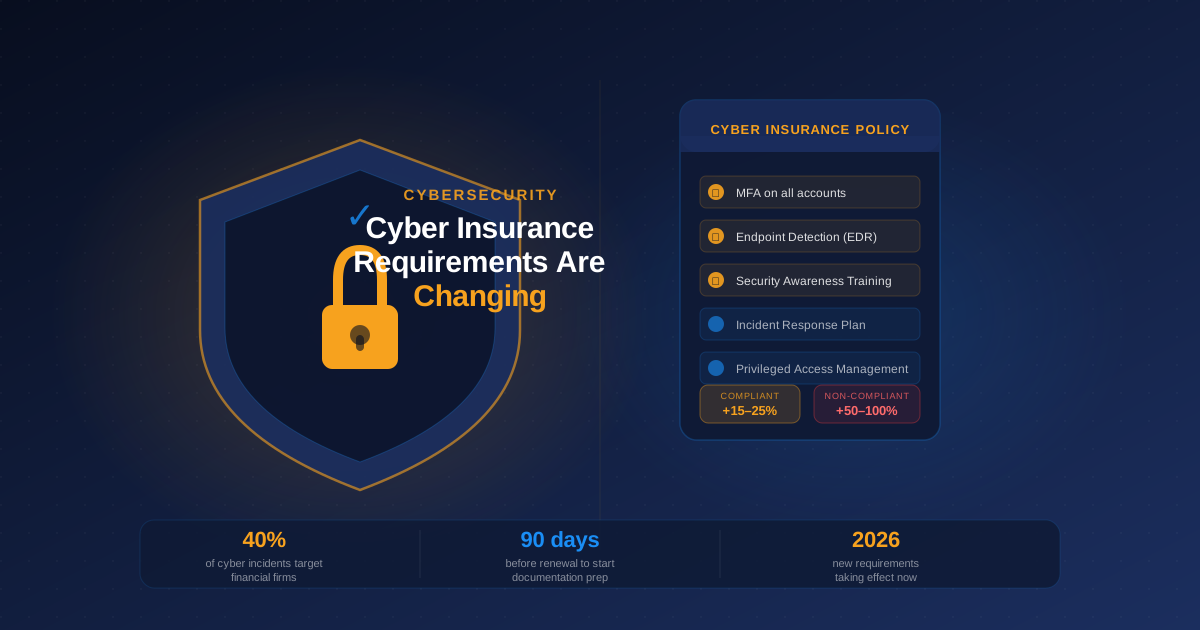
Financial firms are under particular pressure. They are targeted in roughly 40% of all cyber incidents, making them high-risk in insurers' actuarial models. But the changes affect every industry — and every business owner needs to understand what's coming before their next renewal date.
What Insurers Are Now Requiring
The days of self-attestation are largely over. Insurers increasingly want evidence — not just answers to questionnaire checkboxes. Here are the controls that have become effectively mandatory for most policies:
Multi-Factor Authentication (MFA)
Required on all privileged accounts, remote access (VPN), email, and cloud applications. This is the single most scrutinized control — missing MFA will either increase premiums sharply or trigger coverage denial.
Endpoint Detection & Response (EDR)
Basic antivirus is no longer sufficient. Insurers want behavioral endpoint monitoring capable of detecting and responding to threats in real time, deployed across all managed devices.
Security Awareness Training
Documented, recurring employee training — typically quarterly or annual — with phishing simulation records. One-time training completed at onboarding is not enough.
Incident Response Plan
A written, tested IR plan with defined roles, escalation paths, and contact information for legal, PR, and technical response. Untested plans are viewed skeptically by underwriters.
Privileged Access Management
Controls limiting who can access sensitive systems, with audit trails. Insurers are specifically asking about administrator account practices and separation of duties.
Backup & Verified Recovery
Immutable, offsite backups with documented and tested restoration procedures. Insurers have learned that backups that have never been tested often fail when it matters most.
What Happens If You're Not Compliant
The premium impact of non-compliance is significant — and it's getting worse each renewal cycle. Businesses with strong controls in place are seeing modest increases in the 15–25% range, largely reflecting broader market conditions. Businesses with gaps in the core required controls are seeing something very different.
Compliant businesses: +15–25% premium increases. Non-compliant businesses: +50–100% or more, with some seeing coverage denial outright. The difference between having MFA deployed versus not can be tens of thousands of dollars in annual premium — often far more than the cost of implementing the control itself.
Beyond premium pricing, non-compliant organizations are increasingly being offered policies with sublimits — caps that limit coverage to a fraction of the stated policy limit for specific attack types like ransomware. If your policy has a $1M limit but a $250,000 sublimit on ransomware, you may be dramatically underinsured without realizing it.
How to Prepare for Your 2026 Renewal
Start 90 Days Before Your Renewal Date
Rushing to implement controls in the weeks before renewal is a losing strategy. Technical changes take time to deploy and document properly, and insurers can tell when attestations don't match actual security maturity. Starting 90 days out gives you time to identify gaps, prioritize remediation, and gather the evidence documentation your broker will need.
Conduct a Gap Assessment First
Before you can close gaps, you need to know where they are. A structured assessment against the insurer's application questions — ideally with your managed IT provider — will surface the specific controls you're missing or can't adequately document. Focus first on the controls that have the highest premium impact: MFA, EDR, and backup verification.
Document Everything
Having a control in place is not enough if you can't prove it. Insurers and their brokers are increasingly asking for evidence packages: screenshots of MFA configuration, EDR deployment reports, backup test logs, training completion records. Build a documentation folder specifically for insurance purposes and keep it current throughout the year — not just at renewal time.
| Control | What Insurers Want to See | Common Gap |
|---|---|---|
| MFA | Deployment across email, VPN, cloud apps, privileged accounts | Deployed for some users or systems but not all |
| EDR | Named solution, coverage across all endpoints, active monitoring | Traditional AV in place; EDR not deployed |
| Backups | Offsite/immutable copies + documented test restoration | Backups exist but have never been tested |
| IR Plan | Written plan with named roles, tested within 12 months | Plan exists in draft form but hasn't been exercised |
| Training | Recurring cadence + phishing simulation records | One-time onboarding training, no records kept |
| PAM | Admin account inventory, least-privilege enforcement | Multiple users with admin rights, no audit trail |
Working With Your Broker and Managed IT Provider Together
The most effective renewal preparation involves your insurance broker and your IT provider working from the same playbook. Your broker understands what specific insurers are weighting most heavily this cycle. Your IT provider knows what's actually deployed in your environment and what can be realistically implemented before your renewal date.
This collaboration is particularly valuable when there are gaps that can't be fully closed before renewal. A credible remediation plan, documented and signed off by your IT provider, carries real weight with underwriters — especially when the highest-priority controls are already in progress.
Insurance applications are legal documents. Misrepresenting your security posture — intentionally or through poor internal communication between IT and leadership — can void your policy at claim time. The only thing worse than a high premium is a denied claim after a breach.
Frequently Asked Questions
Related reading: Why Employee Offboarding Is Your Biggest IT Security Blind Spot →

Renacy is a managed IT support provider serving businesses across New York, New Jersey, Pennsylvania, Connecticut, Massachusetts, Maryland, and Washington DC. Our team specializes in proactive device monitoring, helpdesk support, cloud backup & disaster recovery, and network infrastructure management. Learn more about Renacy →